 eVerbary
Home / Universities / BYU
Accepted through the evaluationCertified translations for BYU applicants
Brigham Young University: Translation Requirements for Documents in Another Language
BYU asks for a credential evaluation, and IERF, one of the agencies it accepts, takes certified translations from professional services such as eVerbary.
Guaranteed to be accepted by IERF, or your money back. See terms
- ATA member #273062
- Preserves the original layout
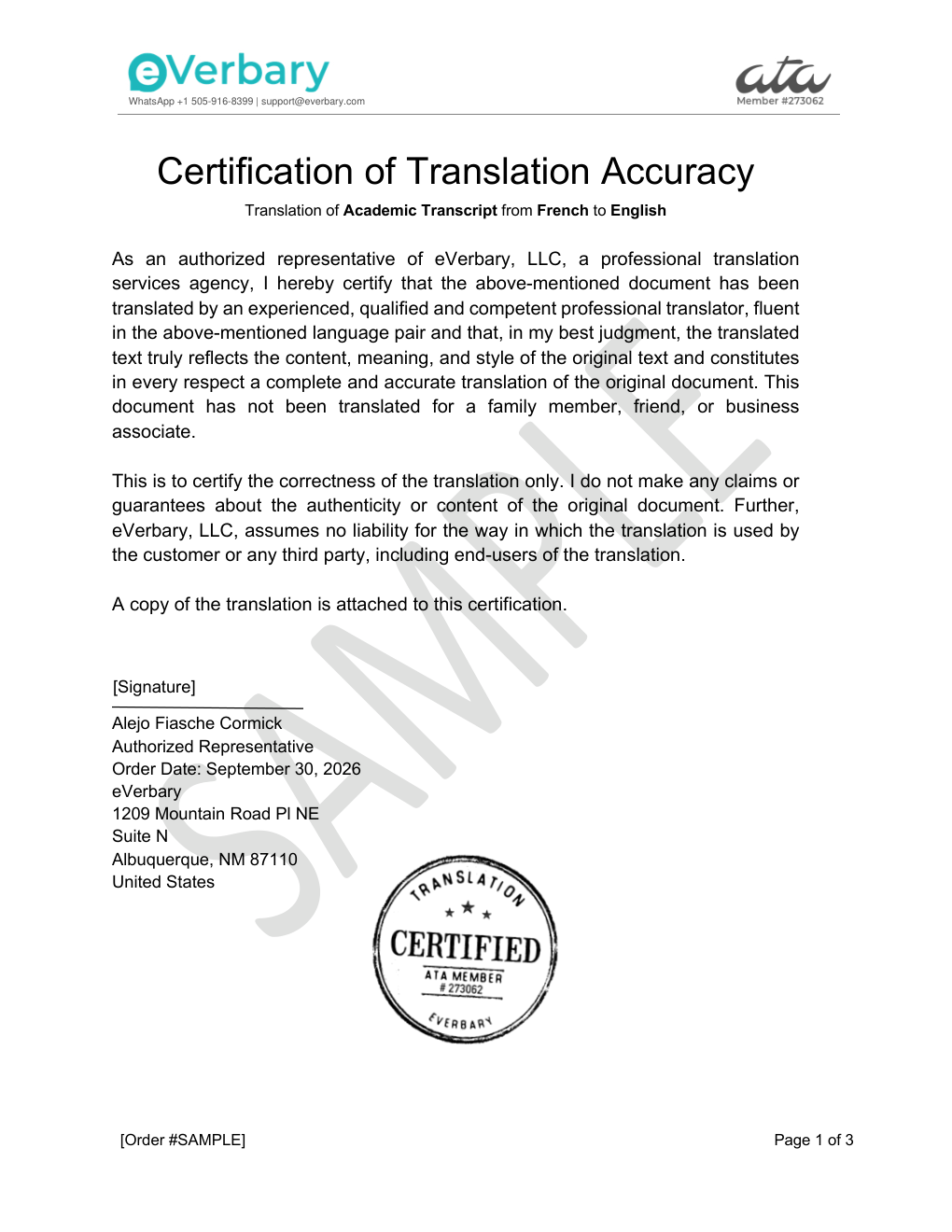
- Signed certificate of accuracy, PDF
- See the price before you pay
What you need for BYU
- eVerbary's certified translation
- Accepted by IERF
- The agency BYU sends you to
- Certificate of Translation Accuracy
- Included
- Signed, with every translation
- A signed statement on our letterhead saying the translation is complete and accurate. It is what makes a translation "certified", and what schools, USCIS and evaluation agencies look for. It is the first page of your PDF.
- Notarization
- Not needed
- A notary public stamps the signature on our certificate to confirm who signed it. The notary does not read or check the translation. BYU doesn't ask for it, so you don't need it.
- Credential evaluation
- Required
- From IERF or another agency BYU accepts. eVerbary doesn't do evaluations.
- An agency such as WES or ECE compares your foreign degree and grades with US ones (equivalency and GPA), and you order it from the agency. eVerbary doesn't do evaluations: we do the certified translation the agency and BYU ask for.
$24.95per page · 24 hours for 1–3 pages · evaluation not included
Order for BYU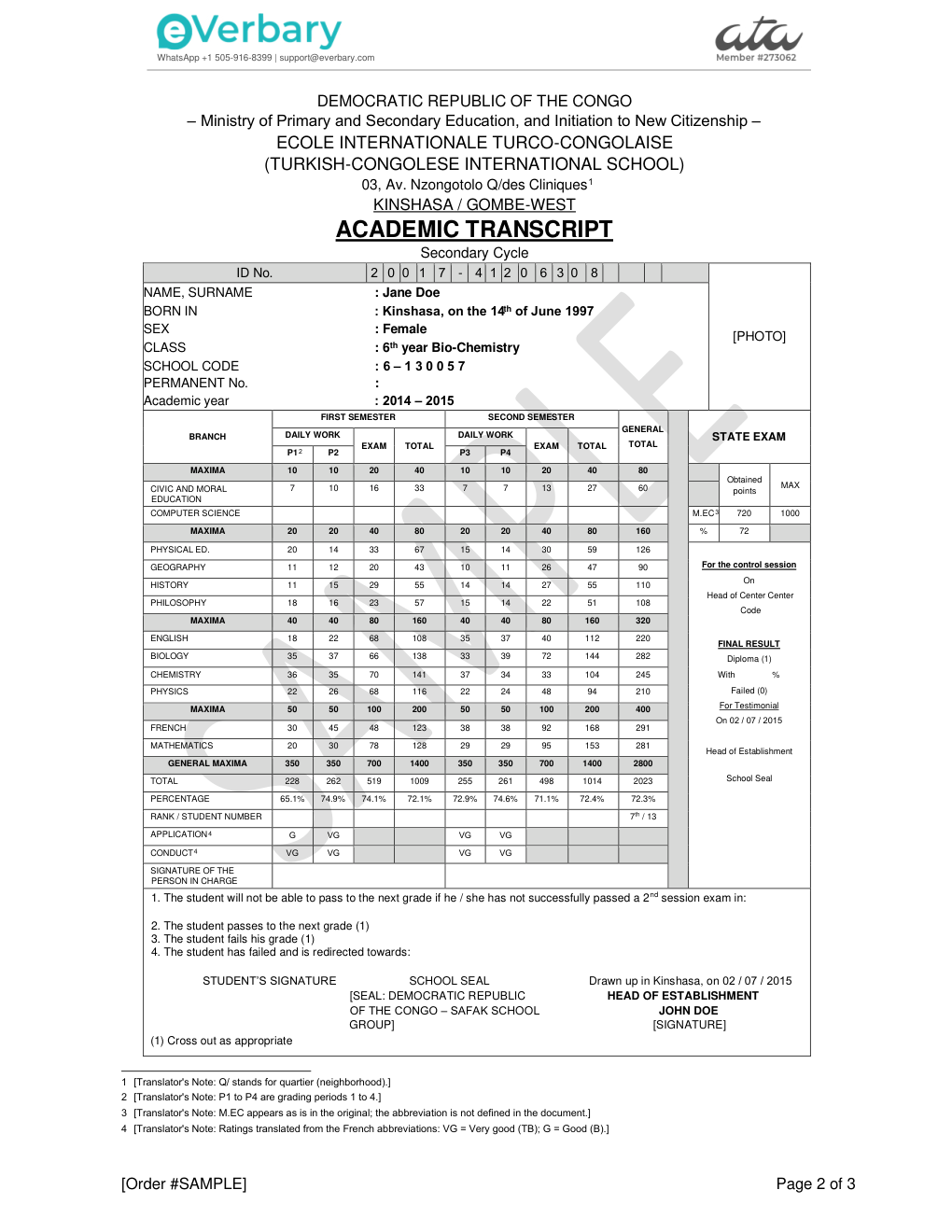 See a sample translationReal order format, fictitious data
Will BYU accept my translation?
YesDoes it accept eVerbary?
BYU asks for an evaluation from IERF or TEC (evaluating international work), and IERF accepts translations, reserving the right to ask for ones prepared by professional translation services (IERF documentation). TEC accepts an outside translation only from an ATA-certified translator (TEC), which eVerbary assigns on request. Policy checked on October 13, 2026.
- eVerbary translatesCertified, usually within 24 hours
- Credential evaluationBy IERF or another agency BYU accepts
- BYUThe agency sends its report
The longer answer
Brigham Young University asks for an evaluation by IERF or TEC (formerly SpanTran), at your expense, of all secondary, pre-university and college work completed outside the US, for first-year, transfer and graduate admission, and it discards international transcripts sent to it directly. BYU's evaluation agencies, such as IERF, accept certified translations from professional services such as eVerbary; TEC takes an outside translation only from a translator certified by ATA, which eVerbary provides on request. BYU itself warns that professional translations may be needed before an evaluation can start, so the translation comes first and the agency's report reaches BYU after it.
Worth knowing about BYU
How it works
Three steps. You see the price before you pay.
- 1Scan every pageScan or photograph every page of the document, front and back, including any stamps on the reverse.
- 2Upload it and see the priceUpload it, choose the language and "certified", and see the price before paying.
- 3Send it to BYUReceive the PDF, usually within 24 hours for one to three pages, and upload it with the copy of the original wherever the institution asks for it.
BYU requirements in detail
In BYU's own words, with a link to each page.
| Translation | No BYU rule for academic records. BYU notes that the agency may require professional translations of documents not issued in English before it evaluates them (Evaluating international work). |
|---|---|
| Evaluation | All secondary, pre-university and college work completed outside the US, including international work reported on a US transcript, at the applicant's expense (Evaluating international work). |
| Agencies | International Education Research Foundation (IERF) or The Evaluation Company (TEC, formerly SpanTran) (Evaluating international work); the graduate school calls them its preferred vendors (Graduate Studies: international applicants). |
| Report | IERF: the CES-specific application, with "Detail Report for BYU" as the purpose and a discounted fee. TEC: the CES-specific application, which gives a discount, faster turnaround and the Course Analysis report BYU needs (Evaluating international work). |
| What the evaluation must cover | Grades 9 to 12 (9th optional where it is not high school), 13th grade if completed, lower and upper secondary, and pre-university work such as A levels, BTEC or CEGEP; a final year still in progress is not required (Evaluating international work). |
| Transfer applicants | Under 24 US-equivalent college credits: college work plus secondary records. 24 or more: all college work. Non-US-accredited college work goes through IERF or TEC (Evaluating international work, transfer). |
| Graduate | An official evaluation from IERF or TEC; some programs want it before you submit, others admit conditionally. Financial documents need official English translations and must be current within 12 months (Graduate Studies: international applicants). |
Checked on October 13, 2026. Sources are listed at the end of this page. Policies change: confirm on BYU's own page before you submit.
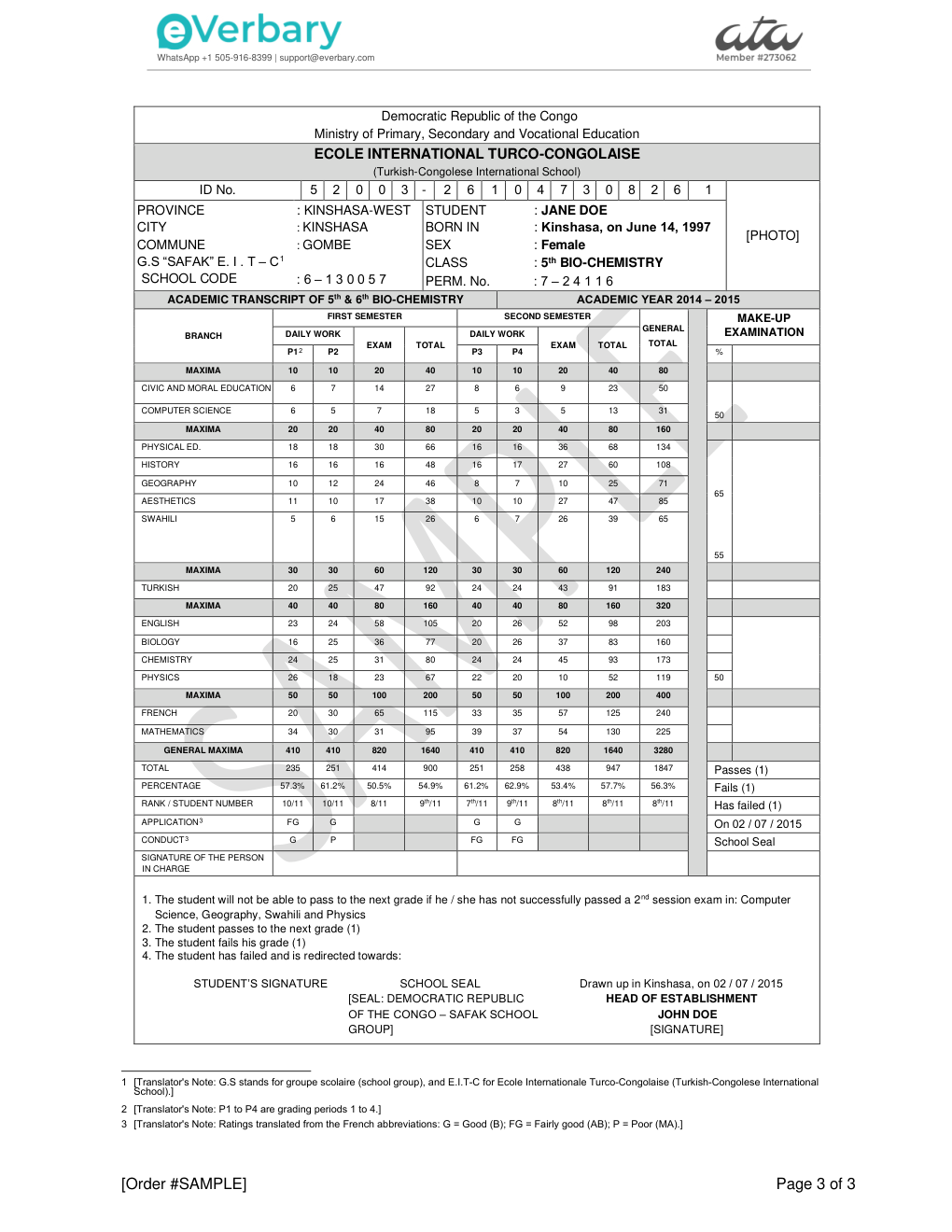
Sample translation: a Congolese secondary school transcript
This is what an order looks like when it is delivered, with a fictitious student. The PDF starts with the signed certification page, and the translation follows the original line for line: every abbreviation is explained, stamps, seals and signatures are noted in brackets, and the grid stays the same, so an admissions officer or a credential evaluator can match it without guessing.
What to notice
- Two school years in the same grid as the original: every subject, grading period, exam and total, so each grade can be read against its maximum.
- The French rating abbreviations are translated (TB becomes VG, Very good), and every abbreviation is explained in a translator's note at the foot of the same page, including one the original never defines.
- Dates are written the US way (the original's 02/07/2015 is February 7, 2015).
- The photo, seals and signatures are noted in brackets where they appear.
Price and delivery
Per page, certification included. Your order shows the exact total before you pay.
| Price | $24.95 per page | Certification included: 4 pages, $99.80 |
|---|---|---|
| Delivery | 24 hours | For 1–3 pages; expedited, about 12 hours (+$4.99 per page) |
| Stamps and seals | Translated | Every page, legalizations and handwritten notes included |
| Layout and grades | As the original | Grades as recorded, never converted to a US GPA |
| Notarization | Not needed | BYU doesn't ask for it ($34.90 if you want it) |
| Hard copy | From $19.95 | Wet-ink signature, by USPS Priority; Express $37.95 |
| ATA-certified translator | Only if asked | Some routes ask for one: $34.95 per page and up, at checkout |
Every eVerbary translation is certified by eVerbary, a member of the American Translators Association (ATA #273062), with a signed certificate of translation accuracy, and all our translators have a university degree in translation. A translator individually certified by ATA is an extra, only for the offices that ask for one. Notarization means a notary stamps the signature on our certificate; the notary does not review the translation.
If you need a translator certified by ATA
All our translators have a university degree in translation, and our regular certified translation ($24.95 a page) is the one USCIS and most schools accept. Not all of them are certified by ATA, though, and some offices ask for a translator who is. When you choose an ATA-certified translator, we make sure one does your translation and signs it with their ATA number. It costs more:
To order it, create your order and keep "ATA-certified translator" ticked among the extras (it comes ticked from this page); you see the total before you pay. If BYU doesn't ask for it, you don't need it. ATA doesn't certify other languages into English, so for those we provide a notarized certified translation instead, at $44.95 per page plus notarization ($34.90 per order), through a free quote; ask BYU to confirm it accepts that, and write its answer in the quote notes.
Documents applicants usually translate
- Lower and upper secondary school records, including a 13th year if completed
- Pre-university results, such as A levels, BTEC or CEGEP
- College or university transcripts and degree certificates, for transfer and graduate applicants
- Bank statements and other financial documents, which the graduate school wants in official English translation
What an eVerbary translation includes
- A complete English translation of every page, stamps, seals and handwritten notes included, laid out like the original so each line can be matched.
- Grades exactly as recorded, with the grading scale the document prints. We never convert marks to a US GPA.
- A signed certificate of translation accuracy on letterhead, with our contact details, delivered as a PDF you can upload.
- $24.95 per page with no word cap, certification included; 24 hours for one to three pages as standard. Regular clients who need it can get delivery in as little as 30 minutes, on request.
Uploading the translation to BYU
The translation goes to IERF or TEC, not to BYU. IERF receives it with your documents (a school or translator may also send documents to IERF directly, quoting your file number); TEC takes it with the online application. The agency then sends its report to BYU (Evaluating international work).
Graduate applicants upload their financial documents, with official English translations, in the graduate application (Graduate Studies: international applicants).
What we do not do
eVerbary is a translation service, not a credential evaluation service: we do not issue evaluations, US equivalencies or GPA conversions, and we cannot send documents on behalf of the school that issued them. For BYU that means we translate your records for IERF or TEC; the evaluation is ordered from the agency, at your expense, after the translation, and the agency sends it to BYU.
What clients say
4.9 from 632 client ratingsThe translation of my High-School transcript was accepted by the Ohio University - thank you!
My diploma was translated accurately into English and my immigration representative said that he had a great experience with you!
THANK YOU!! I'M AT UNIVERSITY NOW!!
Other universities
Frequently asked questions
Can I send my foreign transcripts to BYU directly?
No. BYU discards international transcripts that have not been evaluated, unless an accredited US institution sends them (Evaluating international work).
Does IERF accept a translation from a translation company?
Yes. IERF wants typed, line-by-line, word-for-word translations, may require professional ones, and does not require certification or notarization (IERF: required documentation).
I chose TEC. Can eVerbary translate for it?
Yes, with a translator individually certified by ATA, which TEC requires for outside translations (The Evaluation Company: avoid delays with your evaluation). Add the ATA-certified translator extra when you order and write "TEC, BYU, ATA-certified translator" in the notes. ATA certifies only some languages into English; the section above lists them.
I am applying to BYU and BYU-Idaho. Do I need two evaluations?
No. IERF and TEC evaluations submitted to BYU are available to all CES schools, so one evaluation is enough (Evaluating international work).
Do my bank statements need a translation for BYU graduate admission?
Yes. The graduate school asks for financial documents current within 12 months, with official English translations (Graduate Studies: international applicants).
My school system has a 13th grade. Does it go into the evaluation?
Yes, if you completed it (Evaluating international work). Translate those records too.
Does BYU require a notarized translation?
No. BYU's published rules don't ask for a notarized translation (BYU's rules); a certified translation is enough. Notarization only adds a notary's stamp on the translator's signature; the notary doesn't review the translation. If you want it anyway, it is $34.90 per order.
Do I need an ATA-certified translator for BYU?
Not necessarily. IERF, one of the agencies BYU accepts, takes a certified translation from a professional service such as eVerbary. If you go through an agency or program that asks for a translator individually certified by ATA (see the requirements on this page), eVerbary assigns one on request, from $34.95 per page. eVerbary is a member of the American Translators Association (ATA), member #273062.
How much does a certified translation for BYU cost?
$24.95 per page at eVerbary, with no word cap and the certification included, usually delivered within 24 hours for one to three pages. BYU doesn't ask for notarization, so that is the total. The evaluation is ordered from IERF and paid to it.
Is acceptance by IERF guaranteed?
Yes. Our certified translations are guaranteed to be accepted by IERF, or your money back. The guarantee covers the translation itself, not the evaluation or BYU's admission decision. Full terms are in our refund policy.
Will eVerbary convert my grades to a US GPA?
No. The translation reproduces the grades and the grading scale exactly as they appear. A GPA conversion is credential evaluation, which the institution or an evaluation agency does.
More about BYU's rules
What each evaluation agency asks for the translation
IERF wants translations of every record not officially issued in English, typed, line-by-line, word-for-word and in the same format as the original. It reserves the right to ask for translations prepared by professional translation services and requires them in some instances, which its country pages state; its glossary goes further and lists a professional translation as required for records not issued in English. IERF does not require a certified, notarized or sworn translation. If you send original translations, include full-size photocopies, front and back (IERF: about my documents). IERF has no translation service of its own and points applicants to a partner company with a discount.
TEC says an outside translator must be certified by the American Translators Association; another TEC page speaks of a certified translator, its own team, or another ATA member (The Evaluation Company: facts and fictions). TEC translates in-house for an extra fee, which BYU's page also mentions, but only after your evaluation application is complete. For TEC, ask eVerbary for a translator individually certified by ATA (see below).
The CES application, and what goes into the evaluation
BYU asks you to use the CES-specific application of either agency. On IERF's, choose "Educational Institution" and "Brigham Young University - Undergraduate" where IERF asks how you heard about it, select "Detail Report for BYU", and name the same recipient in the mailing instructions, because IERF works with several BYU departments (Evaluating international work). The report then becomes available to BYU, BYU-Hawaii, BYU-Idaho, BYU-Pathway and Ensign College, so one evaluation covers all of them. IERF starts only when it has every document and fee; rush service costs extra.
The evaluation must show your full secondary education, and every page of it that is not in English has to be translated before the agency can read it: lower and upper secondary, a 13th year if your system has one and you completed it, and pre-university results such as A levels or a BTEC. An IB Diploma can be self-reported in the application instead. BYU discards international transcripts that reach it without an evaluation (Evaluating international work).
Translating documents for BYU?
Upload a scan of your transcript or diploma and see the price and delivery time before you pay.
Sources
Brigham Young University's own pages, read on October 13, 2026. Enrollment figure: Open Doors 2025 fact sheet for Utah (IIE), leading institutions in Utah in 2024/25: number 2, with 1,923 international students.